San Francisco — June 15, 2026 — CloudPilot AI — autoscaling Kubernetes for the most demanding teams — today announced official support for Google Cloud. Teams running Google Kubernetes Engine (GKE) can now connect their clusters to CloudPilot AI to eliminate cloud waste, improve workload resilience, and reduce Google Cloud bills—using a read-only agent that can be onboarded in minutes, touches no sensitive data, and makes no changes to cluster configuration.
This launch extends CloudPilot AI's trusted optimization from AWS to Google Cloud, bringing its signature just-in-time provisioning, workload rightsizing, and predictive Spot handling to GKE users. Azure support is planned for Q3.
You see the waste. You know the fix. You have no time.
You see the waste. You know JVMs need tuning. You'd run Spot if you trusted it. Three problems your team can name — and can't keep on top of.
- Waste — easy to see, hard to stay utilized. 75% of cluster CPU sits idle. But reclaiming it takes constant tuning nobody has time for.
- Tuning — every misconfig becomes an incident. Heap too small means OOM. Limits too tight mean throttling. Both knowable. Neither gets fixed at scale.
- Spot — nobody wants to own the risk. 70% off is real. But nobody can predict when it interrupts.
CloudPilot AI is built to close these gaps automatically—reclaiming the waste you can see, applying the tuning you already know about, and capturing Spot savings without anyone having to own the risk.
Built by the maintainers of Karpenter
CloudPilot AI is uniquely positioned: the team builds and maintains karpenter-provider-gcp—the open-source project that brought Karpenter's "just-in-time, no node groups" provisioning model to Google Cloud. The same engineers also co-founded and maintain Karpenter in the CNCF ecosystem.
In other words, the people building CloudPilot AI for GCP are the same people who wrote and maintain the open-source foundation it relies on. No one understands Karpenter on Google Cloud better than us.
"We didn't just 'adopt' Karpenter for GCP—we built and maintain it in the open-source community. That gives us insight into how node provisioning really behaves on Google Cloud. CloudPilot AI turns everything we learned from maintaining the open-source version into an intelligent autoscaling layer, so production GKE clusters can run both reliably and efficiently."
— Jingkang Jiang, Co-founder & CEO, CloudPilot AI
What CloudPilot AI adds beyond open source
karpenter-provider-gcp gives GKE users a powerful, flexible autoscaling foundation. On top of that, CloudPilot AI adds a context-aware automation layer that takes over the production problems you would otherwise have to handle yourself:
- Resilience by default. CloudPilot AI terminates old nodes only after replacement nodes are Ready and Pods are confirmed Running (graceful handoff); enforces anti-affinity for replicated workloads by default, spreading across at least 2 nodes; and distributes workloads across multiple instance families (
e2,n2,n2d,c2d,t2d) and zones—so any single Spot capacity pool or zone is never a single point of failure. - Workload rightsizing, with first-class Java support. Continuously analyzes real usage and adjusts CPU/memory
requestsin real time so consolidation removes over-reservation while avoiding OOM risk. For Java specifically, CloudPilot AI goes beyond standard resource tuning: it accounts for JVM heap behavior and garbage collection—exactly where VPA-style tools fall short—and right-sizes the heap (with HeapDrift handling and JVM args mutation) so Java services run lean without OOM or GC regressions. Learn more: Java workload optimization. - Faster scaling with image lazy loading + P2P. CloudPilot AI accelerates image pulls in two ways to make autoscaling and node replacement much faster: lazy loading starts containers as soon as the needed image layers are available (no need to wait for the full image), and P2P distribution lets new nodes fetch layers from nearby peers in the cluster instead of pulling everything from a remote registry. Together, nodes come online significantly faster—so autoscaling keeps up with traffic and node handoffs stay graceful. Learn more: Image Accelerator.
- End-to-end observability. A node-level event history (create / delete / replace, each with status and reason) plus real-time dashboards for spend, events, and cost trends—instead of scattered CLI logs.
Connect your GKE cluster in minutes
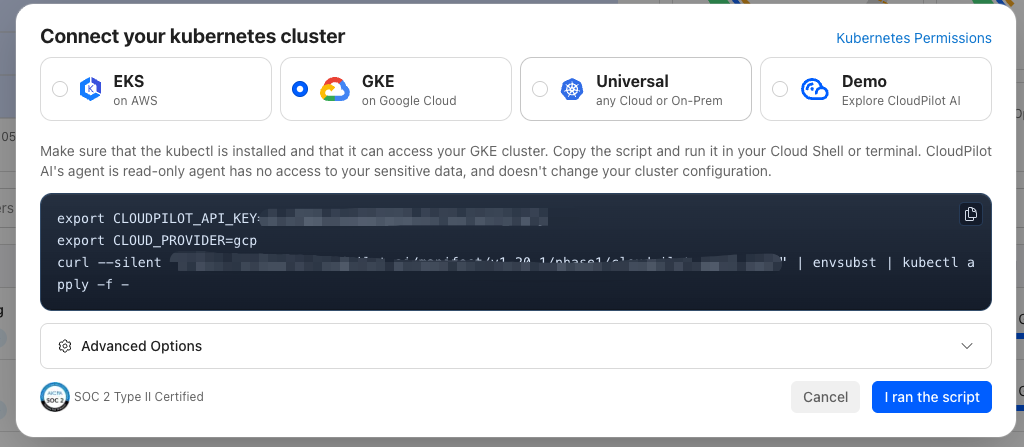
Onboarding a GKE cluster takes a single script. CloudPilot AI's agent is read-only—it can't access your sensitive data and never changes cluster configuration. Choose GKE in the console, run the provided command in Cloud Shell or your terminal, and CloudPilot AI will begin optimizing immediately.
Visit cloudpilot.ai to onboard your first GKE cluster, or book a demo.
About CloudPilot AI
CloudPilot AI delivers autoscaling Kubernetes for the most demanding teams—eliminating cloud waste, improving application performance, and reducing operational risk, all without manual tuning. Based in San Francisco and trusted by 100+ enterprises globally, CloudPilot AI has helped customers save more than $50M in cloud spend, with an average savings rate of 67%, while maintaining reliability at scale.