Without changing a single line of code, this company reduced its real AWS EKS costs by more than 50%, sharply improved cluster resilience, and lowered operational risk—powered by CloudPilot AI's full-stack intelligent autoscaling.
Overview
| Industry | Runtime | Region | Products Used |
|---|---|---|---|
| Generative AI, automated 3D model generation | Amazon EKS (Kubernetes) | Asia-Pacific | CloudPilot AI Workload Autoscaler + Node Autoscaler |
About the Customer
The company is a global leader in general artificial intelligence, dedicated to advancing frontier research and real-world applications of 3D and world-model AI—so that anyone can create, experience, and interact with high-quality spatial content.
Results
The results below are measured across three dimensions: resources, cost, and stability.
| Dimension | Metric | Before | After | Change |
|---|---|---|---|---|
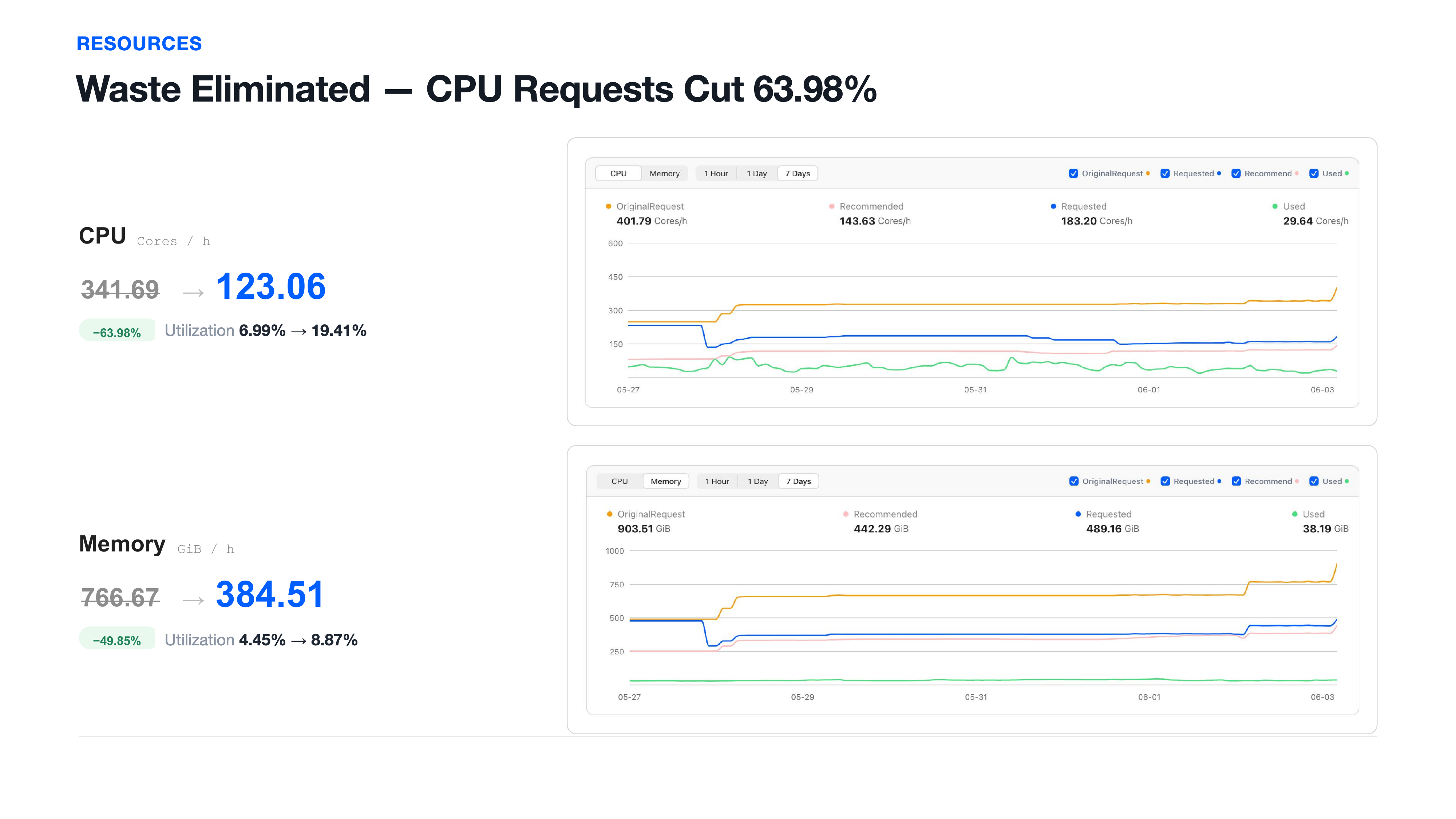
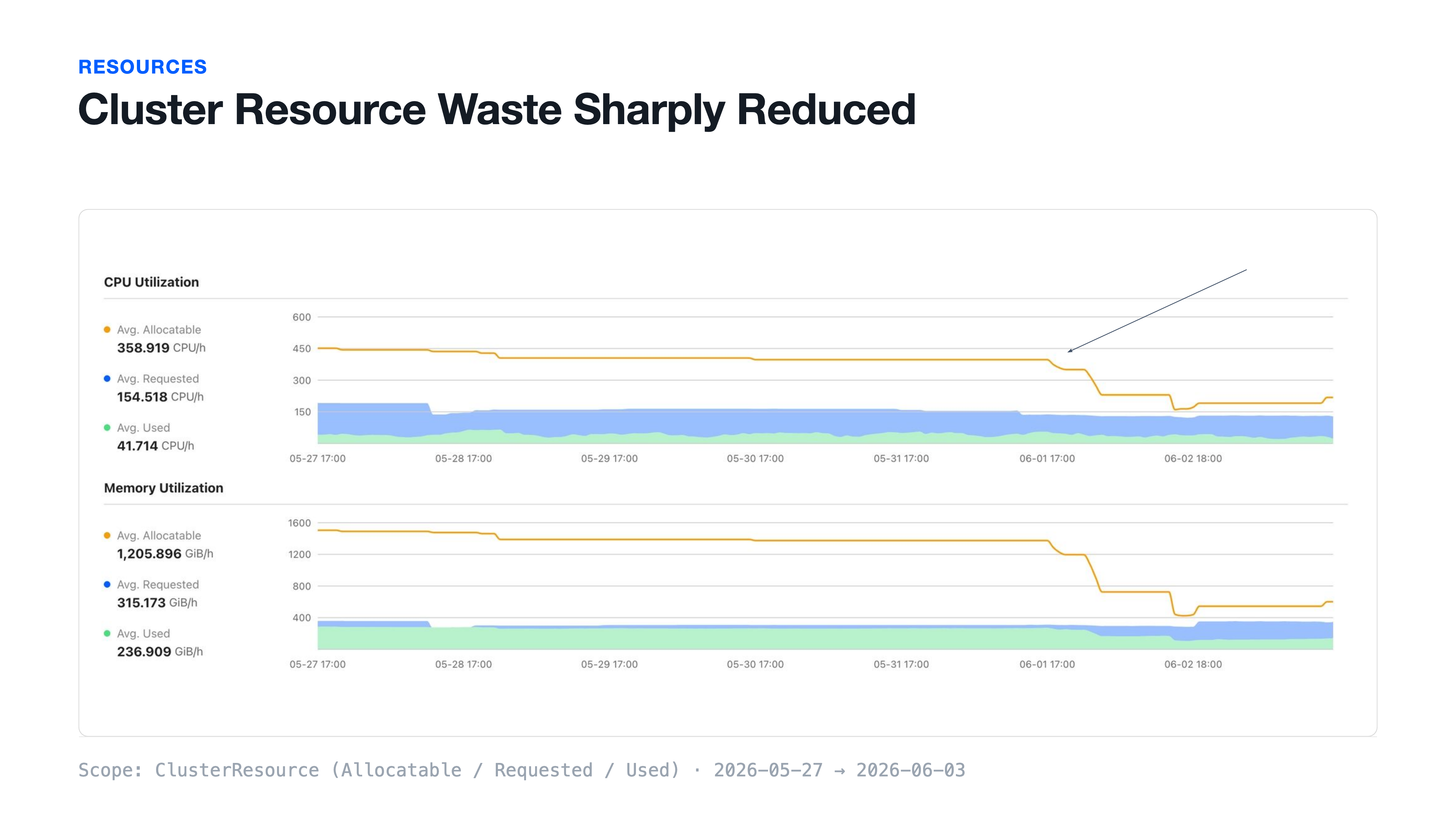
| Resources | CPU Request | 341.69 cores/h | 123.06 cores/h | −63.98% |
| Memory Request | 766.67 GiB/h | 384.51 GiB/h | −49.85% | |
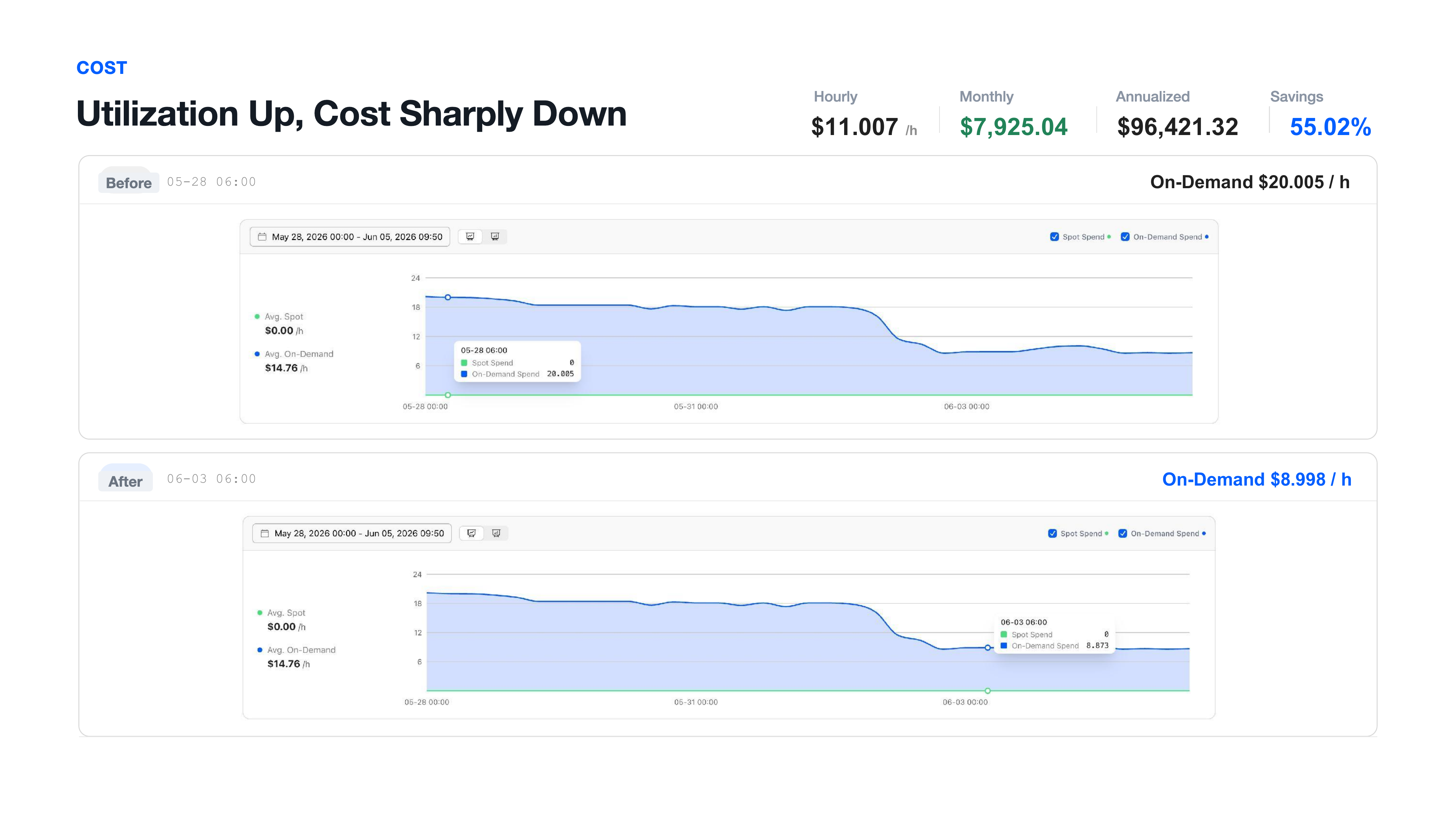
| Cost | EC2 node cost | $20.01 / h | $9.00 / h | −55%, saving ~$7,925 per month and ~$96,421 per year |
- AWS costs down 55%, saving ~$7,925 per month and ~$96,421 per year
- Overall cluster resource utilization improved roughly 3×
- Cluster stability improved dramatically, sharply reducing—and effectively eliminating—OOM / CPU throttle events
- Zero code changes—every adjustment was made through in-place resize
The Challenge: Chronic Over-Provisioning and Mounting Waste
When you build cloud infrastructure to support fast-growing business, stability is usually the first priority. To avoid running out of resources under unpredictable load, engineers reserve far more CPU and memory than workloads actually use. This company was no exception: before adopting CloudPilot AI, its cluster ran at under 7% CPU utilization and under 5% memory utilization—the vast majority of every node sat idle.
Notably, the company was already running AWS EKS Auto Mode (managed, Karpenter-based node provisioning). In other words, even with AWS's own "auto-optimizing" node solution enabled, the cluster remained chronically over-provisioned—because EKS Auto Mode has no workload autoscaler and offers only limited node autoscaling.
Over-provisioning wasn't the only problem. Roughly 19% of containers were under-provisioned—allocated far less than the application actually needed—creating stability risk. In the 30 days before optimization, the cluster logged 47 OOM events, each one a potential hit to a customer-facing service.
Like many teams, this company could "see" the waste through cloud-native monitoring. What it lacked was a way to act automatically, in real time, without jeopardizing production stability.
"We'd actually seen the waste in our dashboards for a long time. But with the business growing so fast, we simply had no time to tune resource configs across thousands of applications one by one—and we didn't dare make risky changes on the production cluster, because stability is our lifeline. What reassured us was the professionalism and ownership the CloudPilot AI team showed during the POC: they thoroughly understood our workloads first, started from the test cluster, and advanced step by step, spelling out the risk and rollback plan for every change. That steady, careful approach is what gave us the confidence to hand them our production cluster."
— Alex, Head of Infrastructure
The Solution: Optimize Workloads and Nodes Together for End-to-End Efficiency
CloudPilot AI was deployed directly on the company's EKS cluster and ran a structured POC across two layers—Pod and Node—without touching a single application.
Workload Autoscaler — Match Every Pod to Real Demand
CloudPilot AI's Workload Autoscaler continuously tunes CPU and memory Requests to fit actual usage, based on historical run data:
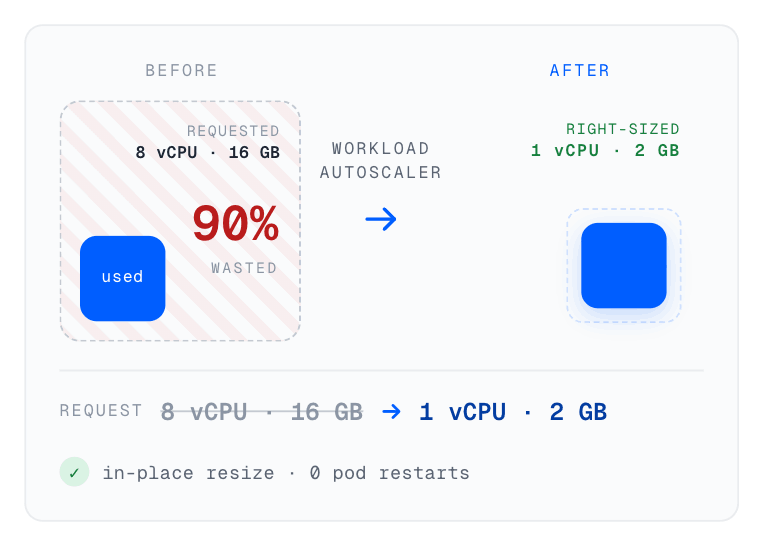
- Rightsizing: Requests follow real load instead of worst-case reservations—one typical workload dropped from 8 vCPU · 16 GB to 1 vCPU · 2 GB.
- In-place resize: Requests/Limits are updated without restarting Pods, so optimization is zero-disruption.
- Better stability: Under-provisioned Pods are automatically corrected, cutting OOM and CPU throttling while reducing cost—rather than trading stability for savings.
Node Autoscaler — Turn Precise Requests into Smarter Nodes
Once application demand reflected reality, the Node Autoscaler reshaped the underlying nodes:
- Intelligent instance selection: Analyzes 800+ EC2 instance types in real time to pick the cheapest, most stable mix.
- Bin-packing: Packs Pods onto fewer nodes and reclaims the idle ones.
- Smart Spot: Predictively selects reliable Spot capacity with automatic fallback. Whereas AWS can only give ~2 minutes of interruption notice, CloudPilot AI's machine-learning prediction can forecast Spot interruptions up to 45 minutes in advance.
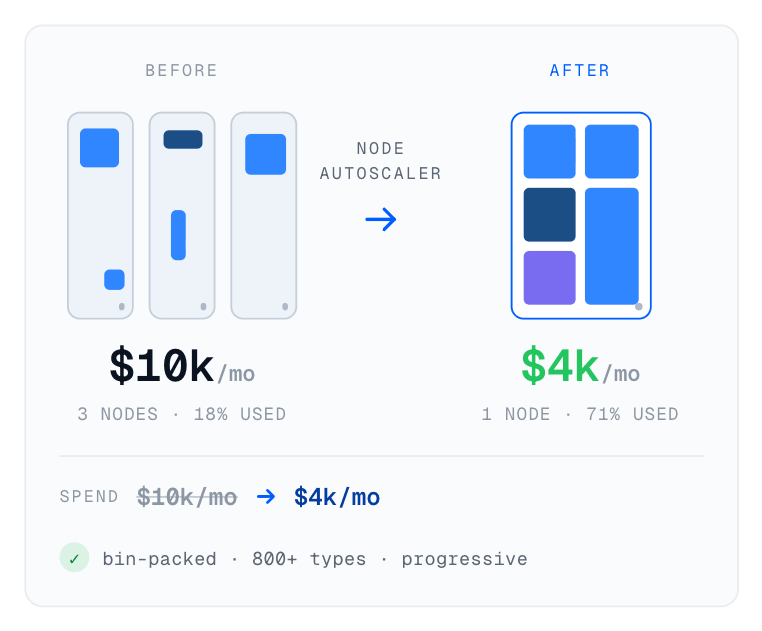
The result of the two layers working together: real node list price fell from $20.01/hour to $9.00/hour (−55%), with utilization up roughly 3×.
How This Differs from EKS Auto Mode
The starting point here wasn't a "bare" cluster—it was one already running AWS EKS Auto Mode (managed, Karpenter-based node provisioning). In other words, all of the results above were achieved by replacing AWS's official "auto-optimizing" node solution with CloudPilot AI. The table below breaks down the capability differences (✓ = has it, ✗ = doesn't).
| Capability | EKS Auto Mode | CloudPilot AI |
|---|---|---|
| Workload Autoscaler | ✗ — Manages nodes only; can't tune workloads or adjust Request/Limit, so the root cause of over-provisioning persists | ✓ — In-place tuning based on real usage: CPU Request −63.98%, memory −49.85% |
| Node Autoscaler | ✓ — Managed scaling based on Karpenter | ✓ — Intelligent selection across 800+ instances + bin-packing; cheaper and more resilient |
| Spot high availability | ✗ — Can only replace Spot nodes reactively, after AWS's ~2-minute interruption notice | ✓ — Predicts Spot interruptions 45 minutes ahead (95%+ accuracy) and migrates proactively; up to 90% of capacity on Spot |
| Spot / On-Demand mixed deployment | ✗ | ✓ |
| Single-replica protection | ✗ — For a single-replica Pod, it deletes first and then recreates, interrupting the service | ✓ — Creates the new replica first, migrates the app, then removes the old replica—no disruption |
| Pricing | ✗ — Adds ~12% management fee on top of EC2 pricing, and it doesn't shrink with Spot / RI / Savings Plan discounts | ✓ — Pay based on realized savings—the industry's only "negative-budget" software product |
In one line: CloudPilot AI saves more and runs more reliably. Auto Mode only answers "how to spin up nodes," while CloudPilot AI works on both the Workload and Node layers at once—filling in the workload tuning and Spot automation that Auto Mode lacks, and eliminating its ~12% management surcharge.
Treating Stability as a First-Class Outcome
For a cloud-native infrastructure company, stability leaves no room for compromise. The standout result of this engagement wasn't just the cost curve—it was that, by right-sizing Pods to real demand and automatically fixing under-provisioned workloads, CloudPilot AI removed a long-standing stability risk while cutting cost.
Because every change was made in place, the entire process required no maintenance window, no redeployment, and not a single new line of code.
Beyond cost and stability, the automation itself unlocked engineering efficiency: the team no longer has to manually re-tune Requests and thresholds, pick node types, analyze resource fragmentation, or maintain scaling policies.
"What surprised us most was that as costs came down, stability actually got better. Throughout the POC, the CloudPilot AI team treated our cluster as if it were their own: fast to respond, diligent in follow-up, and proactive in tracking down issues—true ownership. For a stability-first team like ours, that service experience is genuinely rare."
— Alex, Head of Infrastructure
Frictionless Procurement via AWS Marketplace
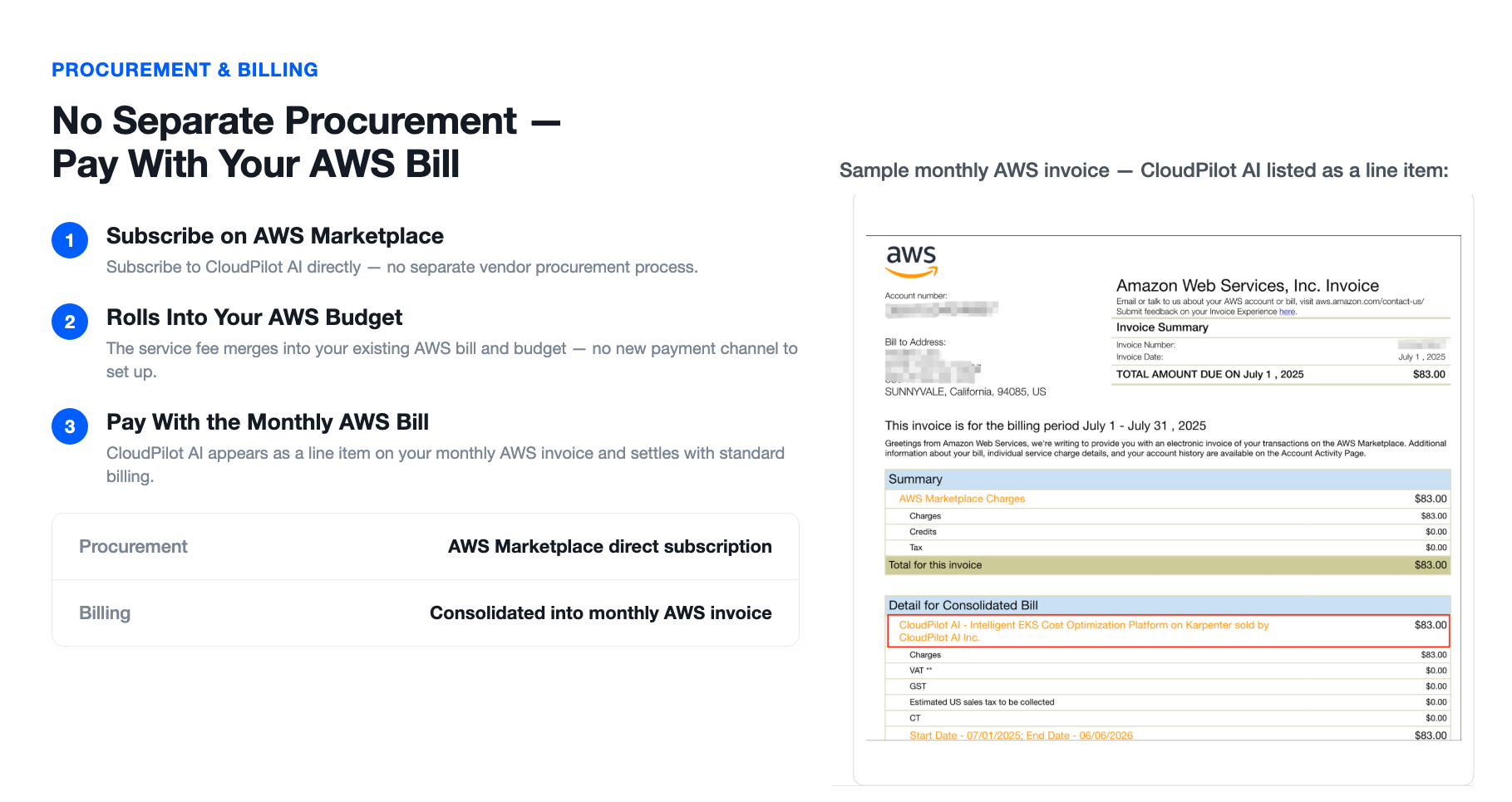
The company subscribed to CloudPilot AI directly through AWS Marketplace—effectively adding a new cloud service in the AWS console, with no new payment channel to set up. CloudPilot AI appears as a line item on the monthly AWS bill and settles alongside standard billing.
At entry-tier list pricing, CloudPilot AI's service fee was only about 11.4% of the cloud savings realized over the same period, for an entry-tier ROI of roughly 7.8×. As committed scale grows, the unit price drops further, and both the net savings ratio and ROI continue to climb.
What's Next
The current results are based on a deliberately conservative configuration. Both teams have laid out a longer-term roadmap:
- Expand Workload Autoscaler coverage — A small number of workloads are not yet fully onboarded; broadening coverage propagates savings further down to the node layer and maximizes the return.
- Tune elasticity policies to unlock more savings — The current scaling policy is still conservative, leaving considerable headroom in the cluster.
- Launch GPU virtualization and elasticity — Improve GPU workload utilization through GPU virtualization and CloudPilot AI's intelligent autoscaling.