
How a Global Gaming Company Cut EKS Node Costs by 47% with Workload, Node, and Spot Optimization
 CloudPilot AICloudPilot AIPublishedSep 18, 2026Read9 min
A global gaming company faced three persistent challenges on AWS EKS: overprovisioned workloads, excess node capacity, and the operational complexity of running reliably on Spot Instances. By coordinating CloudPilot AI's Workload Autoscaler, Node Autoscaler, and Spot Automation, the team tripled CPU utilization, increased memory utilization by 25%, and reduced required node capacity by approximately 14%—all without changing application code. The result was a 47% reduction in EKS node costs.
At a Glance
| Industry | Environment | Headquarters | CloudPilot AI Capabilities |
|---|---|---|---|
| Gaming | Amazon Elastic Kubernetes Service (EKS) | APAC | Workload Autoscaler, Node Autoscaler, Spot Automation |
CloudPilot AI manages multiple large-scale EKS clusters totaling more than 1,000 vCPUs. All three capabilities—Node Autoscaler (NA), Workload Autoscaler (WA), and Spot Automation—are enabled across these clusters.
About the Customer
The customer is a global gaming company serving players worldwide.
Online gaming workloads are highly variable, yet the services behind them must remain continuously available. Infrastructure needs to respond quickly to changes in demand without carrying large amounts of idle capacity as a permanent safety buffer. The company wanted to improve Kubernetes resource utilization and reduce both cloud costs and the operational risks of Spot Instances—without compromising reliability.
Results
CloudPilot AI optimized workloads, nodes, and Spot capacity together, aligning resource allocation with actual demand and turning workload efficiency into lower infrastructure costs.
| Area | Before CloudPilot AI | Result | Business Value |
|---|---|---|---|
| Workload utilization | Pod requests were significantly higher than actual usage, leaving substantial resources overallocated | CPU utilization tripled; memory utilization increased by 25% | Reduced workload-level overprovisioning and aligned requests more closely with actual usage |
| Node utilization | Large amounts of spare node capacity were retained to protect reliability | Multi-instance-type selection and bin packing reduced required node capacity by approximately 14% | Allowed node capacity to scale with demand while preserving headroom for growth |
| Spot Automation | The team wanted to use lower-cost Spot Instances but was concerned about interruptions and migration complexity | With Spot, WA, and NA working together, EKS node costs fell by 47% | Expanded the savings available from Spot while prioritizing reliability and reducing operational overhead |
The Challenge: Balancing Utilization, Elasticity, and Cost
Before adopting CloudPilot AI, the company evaluated Cluster Autoscaler and AWS Savings Plans. Neither node autoscaling nor commitment-based pricing could address the underlying resource inefficiencies end to end.
Cluster Autoscaler primarily solves node-level scaling. If a Pod's CPU and memory requests remain far above actual usage, a node autoscaler still sees inflated demand. Nodes may scale up and down, but the cluster can remain underutilized because workload resources are overprovisioned.
AWS Savings Plans can lower unit prices, but they require a long-term commitment. For variable workloads, committing to one or three years of usage can limit infrastructure flexibility. If actual demand falls below the commitment, the headline discount may not translate into realized savings.
Spot Instances cost less, but interruptions and migrations need to be managed systematically. Online gaming services have stringent availability requirements. Safely moving a single-replica service, keeping multiple replicas from concentrating in the same failure domain, and provisioning replacement capacity in advance all determine how broadly Spot can be used.
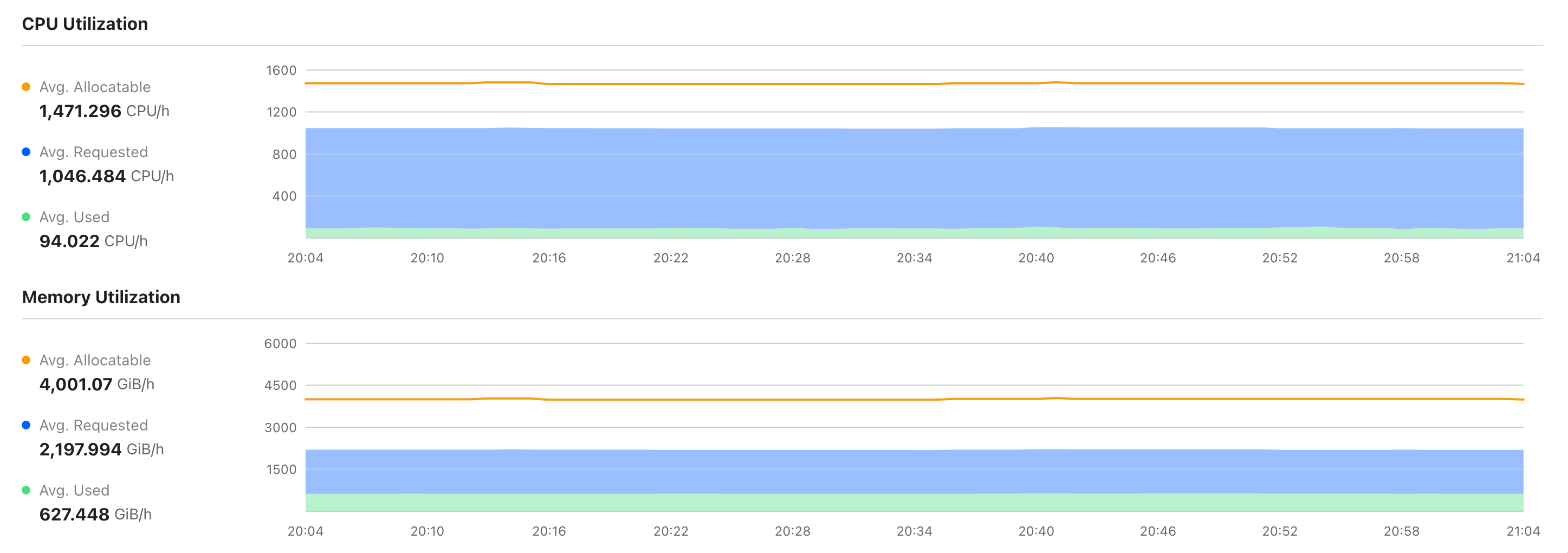
The clearest symptom was the gap between requested resources and actual consumption: before optimization, overall cluster CPU utilization was just 5%, while memory utilization was only 15%.
The company needed an integrated approach spanning Pods, nodes, and Spot capacity: first eliminate workload overprovisioning, then optimize node capacity, and finally expand Spot usage within clearly defined reliability guardrails.
"We had evaluated Cluster Autoscaler and AWS Savings Plans. Cluster Autoscaler only handles node scaling—it doesn't adjust workload requests based on actual usage. Savings Plans lower unit prices, but they lock you into one to three years of committed usage, which conflicts with how much our gaming workloads fluctuate. And for Spot, we would still have needed separate tools for interruption prediction and migration, and to maintain them ourselves.
We chose CloudPilot AI because it brings workload optimization, node optimization, and Spot automation together in one platform, with all three working in coordination. What matters most to us is that the core optimizations required no application code changes—and that as costs came down, reliability stayed our top priority."
— Jack, Head of Infrastructure
The Solution: Three Coordinated Layers of Optimization
Workload Autoscaler — Aligning Requests with Real Demand
CloudPilot AI's Workload Autoscaler continuously analyzes historical CPU and memory usage and adjusts requests to reflect actual demand instead of sizing every workload for peak or worst-case conditions.
- Continuous rightsizing: CPU and memory requests are optimized using real usage data. One representative workload was rightsized from 8 vCPUs and 16 GB of memory to 1 vCPU and 2 GB.
- In-place resizing: Where supported by the environment, requests and limits can be updated without restarting Pods, reducing the operational impact of resource changes.
- Reliability-aware optimization: The system not only reduces oversized allocations; it also identifies underprovisioned Pods to lower the risk of out-of-memory errors and CPU throttling.
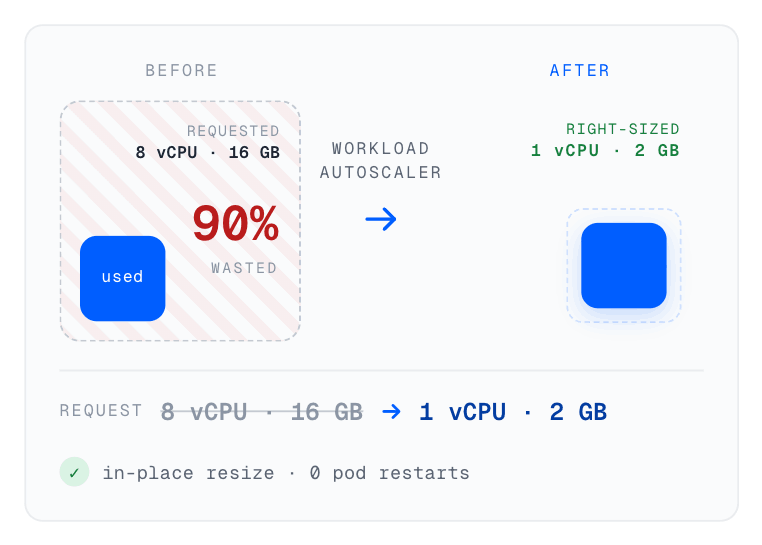
Once requests reflected actual demand more closely, the scheduler stopped reserving capacity for demand that rarely materialized, creating room for further node-level optimization.
Node Autoscaler — Turning Workload Efficiency into Infrastructure Savings
Capacity freed at the workload layer only affects the cloud bill when the node layer adjusts accordingly. CloudPilot AI's Node Autoscaler selects the most efficient mix of nodes based on real-time workload demand and continuously removes capacity that is no longer needed.
- Intelligent instance selection: The system evaluates more than 800 Amazon EC2 instance types and selects combinations based on price, availability, capacity, and reliability.
- Bin packing: Pods are placed on fewer nodes while honoring scheduling and availability constraints.
- Automated reclamation: When capacity is no longer needed, workloads are migrated safely and idle nodes are released.
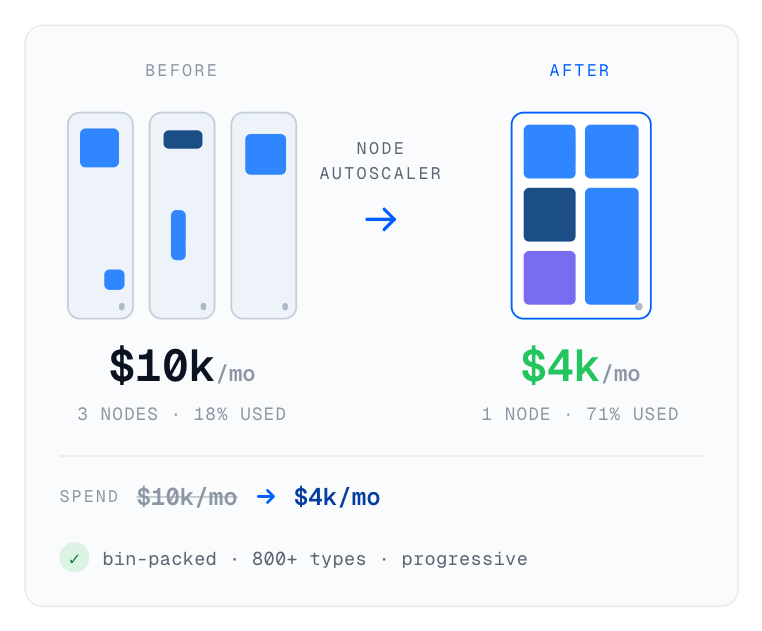
Broader instance-type selection and tighter Pod placement converted lower Pod requests into real infrastructure savings.
Spot Automation — Making Low-Cost Capacity Production-Ready
Spot Instances offer substantial cost advantages, but only when the platform can manage interruptions. AWS typically provides an interruption notice roughly two minutes before termination. CloudPilot AI combines forecasting, scheduling, and migration to identify interruption risk up to 45 minutes in advance and prepare replacement capacity for affected workloads.
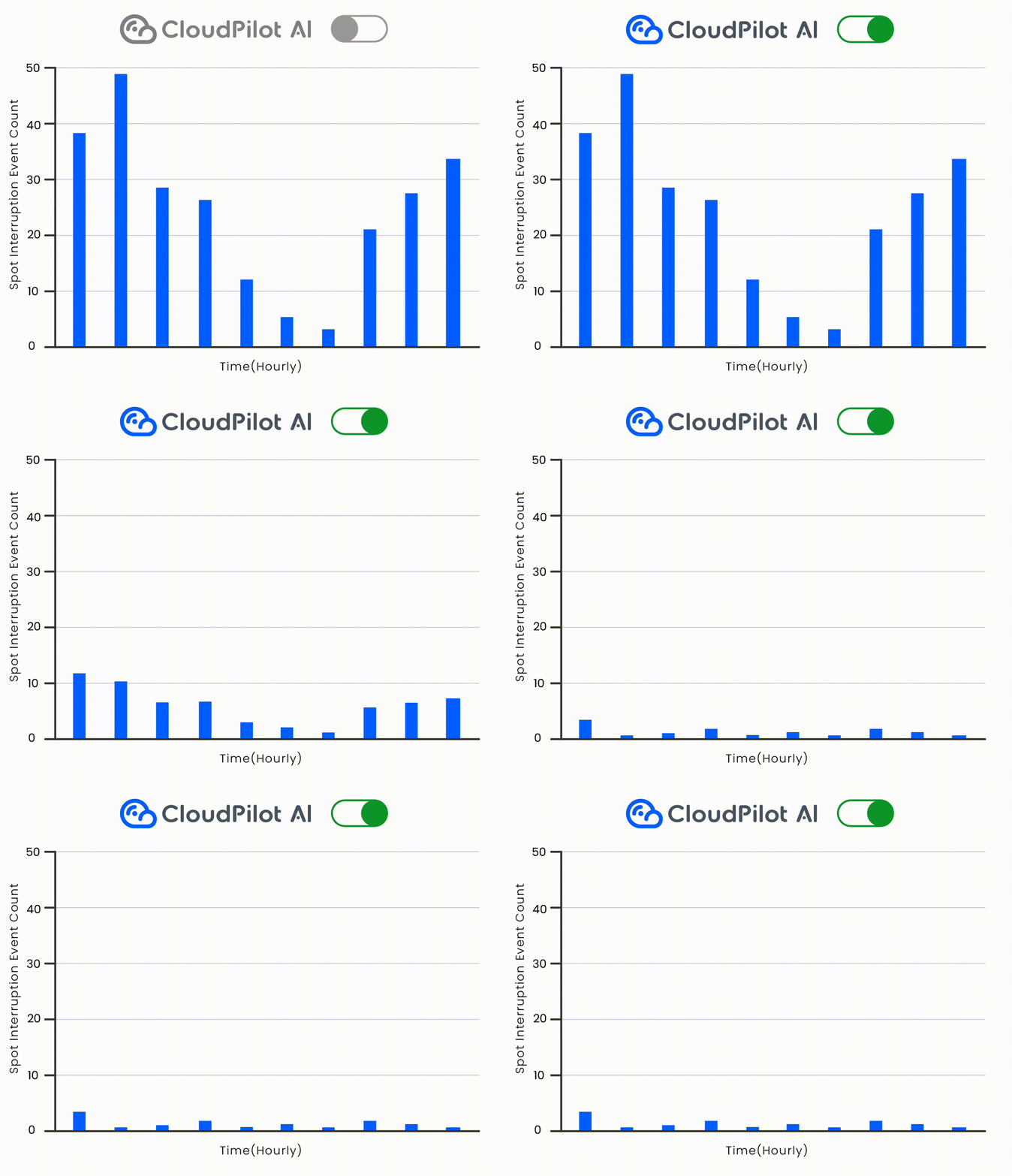
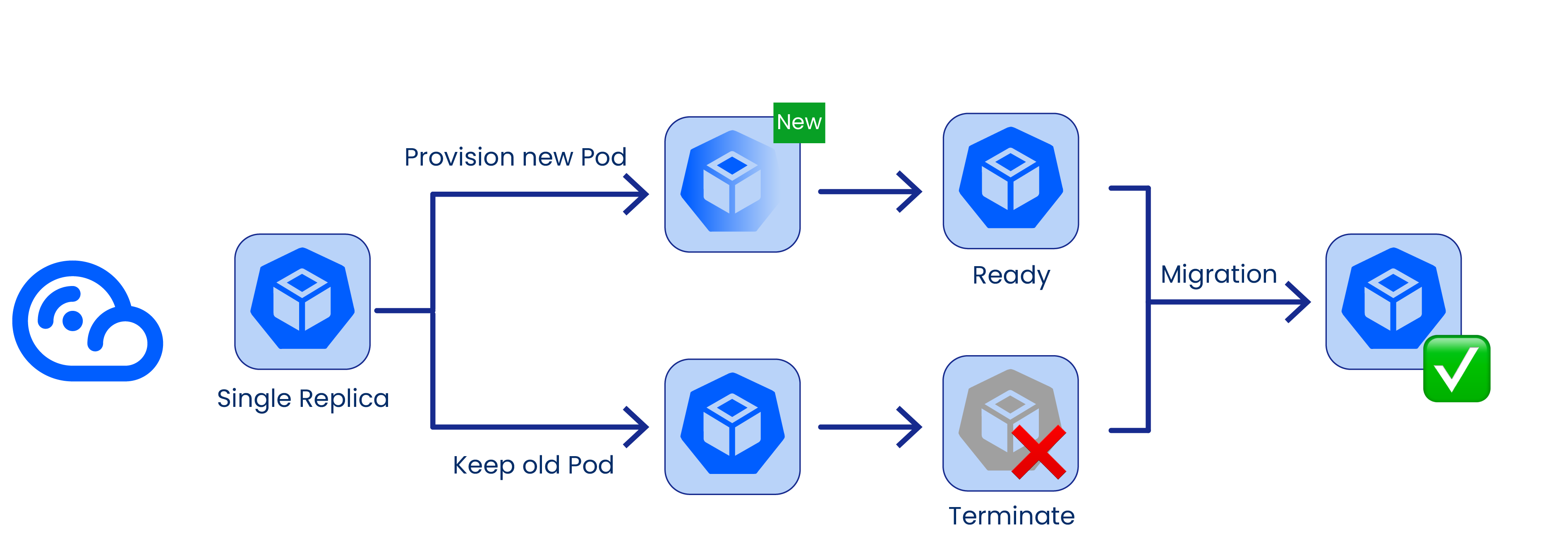
Single-Replica Services: Controlled Rollouts for Safer Migration
When CloudPilot AI predicts an elevated risk of Spot interruption, it can trigger a controlled rollout to migrate a stateless, single-replica workload. A replacement Pod is brought online before the existing Pod exits, reducing the risk of service disruption during the transition.
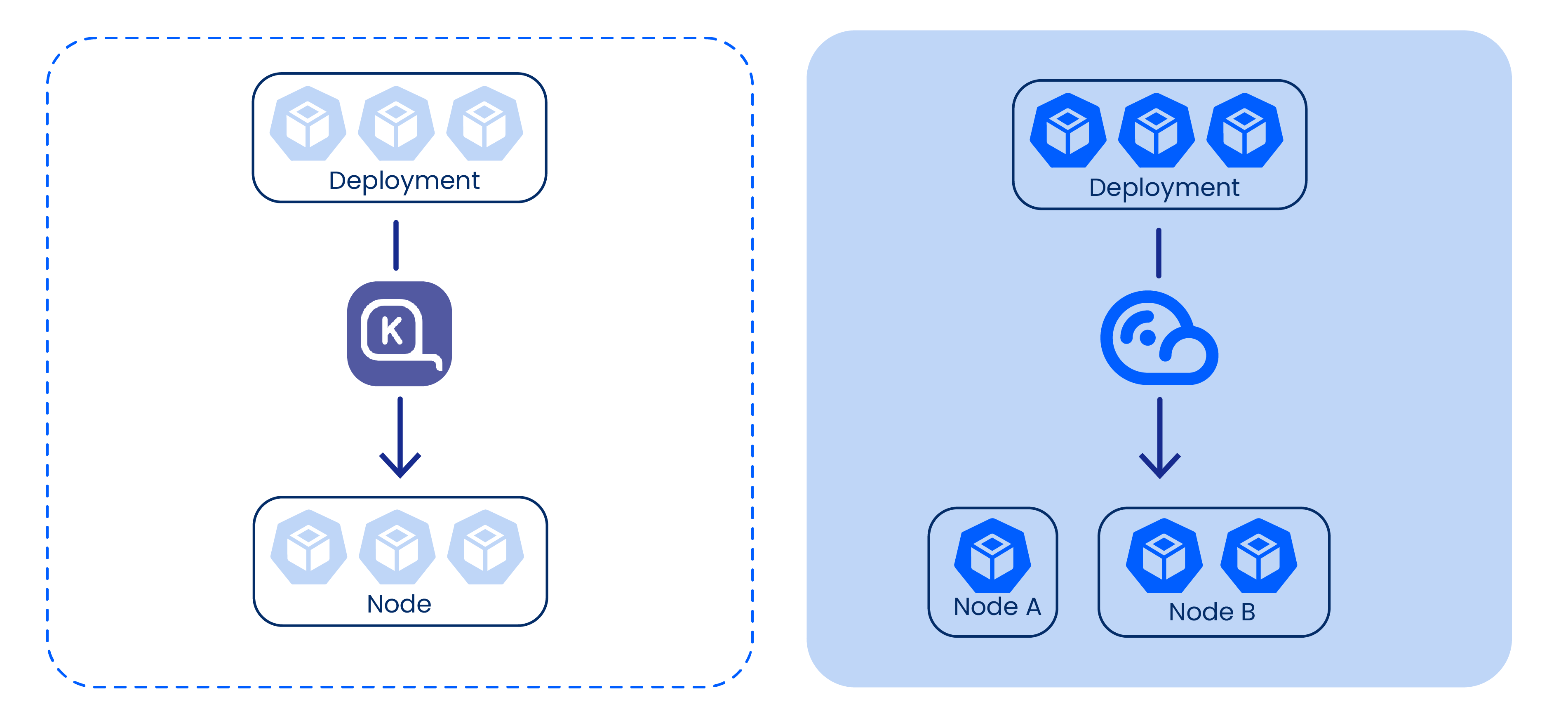
Multi-Replica Services: Proactively Distributing Failure Risk
For multi-replica services, CloudPilot AI uses scheduling policies to prevent replicas from becoming overly concentrated. Distributing replicas across nodes reduces the impact of any single Spot node interruption on the service as a whole.
Together, forecasting, workload migration, and replica distribution make Spot easier to adopt. Instead of being cheaper capacity that requires manual intervention, Spot becomes a reliable, production-ready capacity source managed by the platform.
CloudPilot AI vs. Commitment-Based Savings
| Approach | Cost Savings | Elasticity | Resource Utilization | Commitment |
|---|---|---|---|---|
| CloudPilot AI | 47% lower EKS node costs in this case | High; capacity scales with workload demand | Continuously optimizes actual resource requirements | No long-term usage lock-in |
| Illustrative 1-Year Savings Plan | Approximately 28% headline discount | Constrained by committed usage | Does not directly address resource waste | 1-year commitment |
| Illustrative 3-Year Savings Plan | Approximately 50% headline discount | Constrained by committed usage | Does not directly address resource waste | 3-year commitment |
These figures are not directly comparable. Savings Plans reduce unit prices through committed spend, while CloudPilot AI reduces both the amount and cost of the infrastructure actually required. In this case, CloudPilot AI reduced EKS node costs by 47% without locking the customer into one or three years of committed usage. For variable workloads, this preserves the flexibility to scale infrastructure as demand changes.
Note: Actual Savings Plan discounts vary by instance type, region, payment option, and commitment term. The figures above are illustrative and highlight the structural differences between the approaches.
The Outcome: 47% Lower EKS Node Costs
Together, the three layers of optimization reduced EKS node costs by 47%. The cost data below, with identifying details removed, shows the measured reduction.
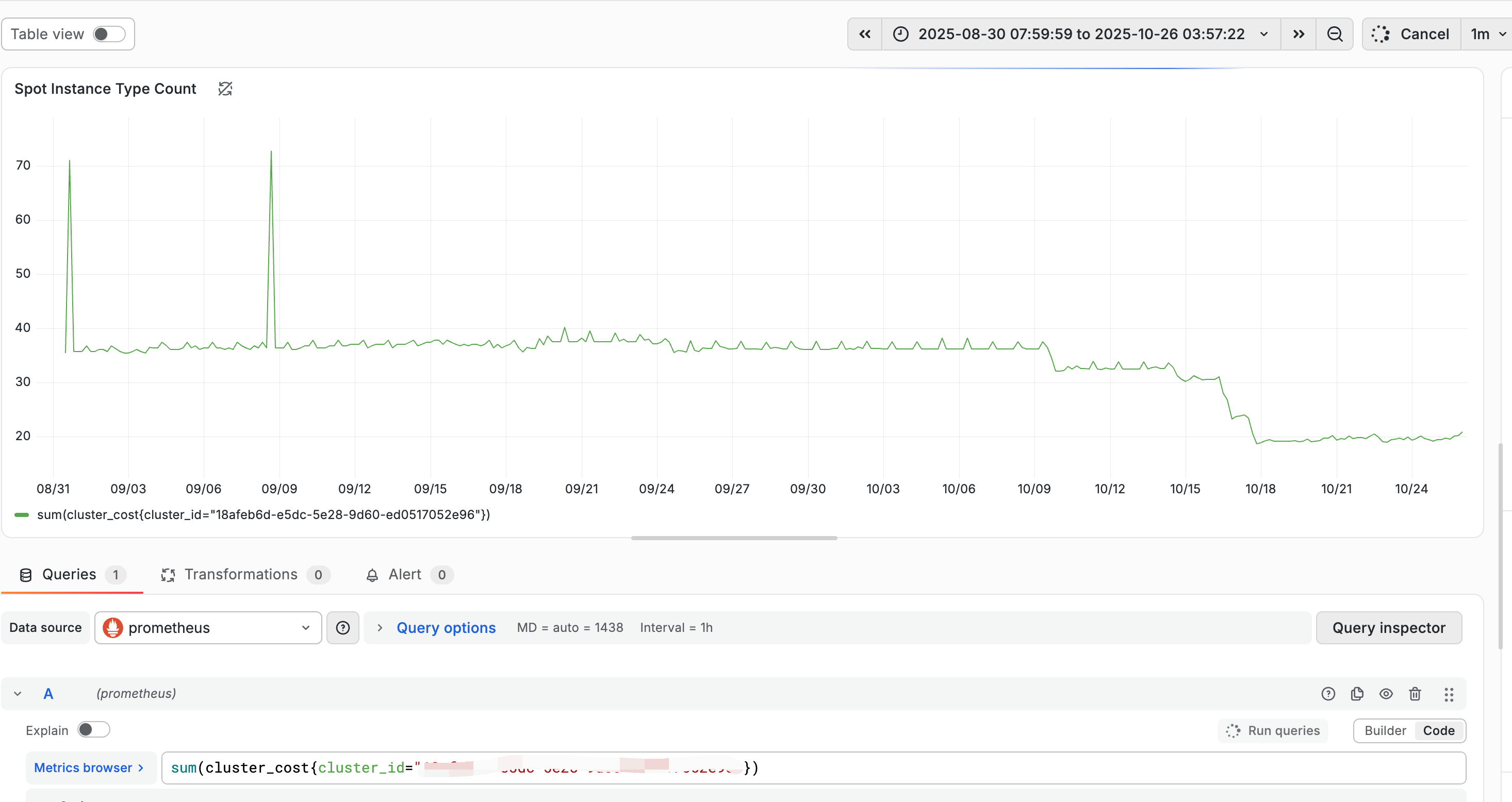
This was not the result of a single discount. It came from optimizing resource demand, node supply, and purchasing strategy together.
Reliability as a First-Class Requirement
For the company, cost optimization could not be separated from service reliability. CloudPilot AI optimized CPU and memory allocations without requiring application code changes, then helped the team improve graceful termination behavior so workloads could use Spot Instances more safely.
Workload Autoscaler avoids cutting resources below what applications need. Node Autoscaler reclaims capacity only after satisfying scheduling and availability constraints. Spot Automation proactively migrates workloads before an instance exits. Reliability is not an afterthought—it is the prerequisite for every layer of optimization.
What's Next
The two teams plan to extend these results from core gaming workloads to additional use cases and expand the CloudPilot AI deployment to more business-critical services.
About CloudPilot AI
CloudPilot AI is a cloud infrastructure company based in San Francisco, specializing in autonomous Kubernetes optimization for enterprises operating at scale.
Its mission is to make Kubernetes autoscaling work for the world's most demanding teams.
The platform continuously right-sizes workloads, scales node capacity, accelerates container image delivery, automates workload placement, and enables high-performance local storage for I/O-intensive applications. Together, these capabilities help SRE and platform teams reduce cloud costs, improve application performance, and maintain reliability across multi-cloud environments—without manual tuning.
More than 100 enterprises worldwide trust CloudPilot AI to reduce cloud costs, with customers achieving average savings of 67%.
Related articles
How a Generative AI Company Cut AWS EKS Costs by 55% with Full-Stack Intelligent Autoscaling
A leading generative AI company reduced its real AWS EKS costs by more than 50% and sharply improved cluster resilience—without changing a single line of code. See how CloudPilot AI's full-stack autoscaling rightsized workloads and reshaped nodes on top of EKS Auto Mode.
CloudPilot AI·8 min
Netvue Achieves 52% Reduction in GPU Costs using Automation
Discover how Netvue reduced GPU inference costs by 52% using CloudPilot AI. Learn how Kubernetes-based scheduling, Spot instance automation, and multi-cloud flexibility helped build a scalable, high-performance AI infrastructure.
CloudPilot AI·7 min
Trenz Achieves 60% AWS Cost Savings with CloudPilot AI
Cut AWS costs by 60% with CloudPilot AI—smart Spot instance scheduling, seamless Spark optimization, and fully automated K8s scaling.
CloudPilot AI·6 minThe Kubernetes Autoscaling Brief
Once a month: what we see in the Spot market, one real cluster torn down, and what shipped.
No spam. Unsubscribe anytime.