
CloudPilot AI Newsletter · October 2026
 CloudPilot AIMarketing TeamPublishedOct 22, 2026Read5 min

This roundup brings together recent CloudPilot AI updates for resource optimization, node operations, and cost visibility. Explore three customer stories alongside marketplace availability and the MCP preview.
In Focus: Memory Extension for Supported EKS Nodes
Memory Extension first compresses inactive pages into an in-RAM compressed cache; pages move to root-disk-backed cold memory only when that cache is full. This helps supported workloads absorb growth above memory requests and reduce avoidable node-level out-of-memory failures. It requires CloudPilot AI-managed AWS NodeClasses using Amazon Linux 2023 and nodes with at least 4 GiB of physical memory; configuration applies to newly created nodes, and normal requests, limits, and capacity planning still apply.
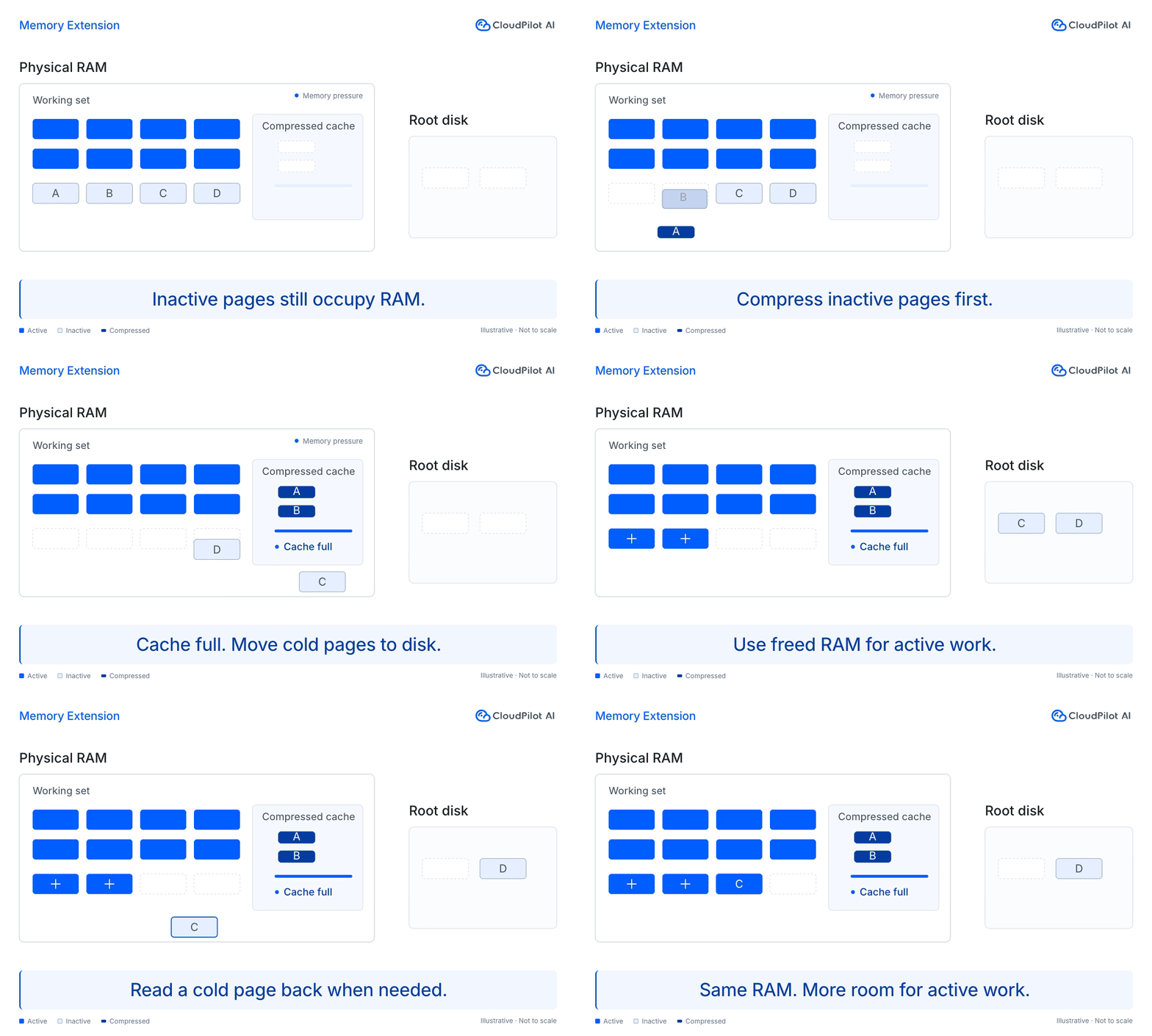
Watch the 24-second Memory Extension demo · Silent; opens in your browser.
Memory Extension requirements and configuration
Product Updates
Finer JVM Controls and CPU Pressure Protection
Independent minimum and maximum bounds for Xms and Xmx give teams finer control over JVM recommendations, using absolute quantities or percentages of a trustworthy original heap baseline on compatible managed clusters. CPU Pressure Stall Information makes downsizing more conservative when supported telemetry shows sustained pressure, while leaving normal usage-based recommendations unchanged when PSI data is insufficient.
JVM heap bounds and compatibility · CPU PSI recommendation protection
Control Disruption Timing and AWS Spot Selection
Disruption Cooldown spaces voluntary disruption batches across managed AWS, GKE, and AKS NodePools, with cluster defaults and per-pool overrides while disruption budgets continue to limit each batch. AWS clusters can choose lowest-price or price-capacity-optimized Spot allocation; lowest-price remains the default.
NodePool lifecycle and disruption cooldown · Cluster settings for AWS Spot allocation
Clearer Scheduling Diagnostics and Node Actions
Instance candidates, scheduling diagnostics, and optimization wait reasons help explain placement constraints and blocked optimization; candidate compatibility does not guarantee live cloud capacity. Console node actions include Cordon, Uncordon, Drain, Force Drain, and Delete for NodeClaim-managed nodes, while component status and live logs support troubleshooting.
Node Autoscaler configuration and operations · Component state and troubleshooting
Understand Workload Costs and Unused Requests
Workload cost views estimate CPU and memory costs by workload and NodePool, with trends and resource-efficiency views to help prioritize unused requests and estimated hourly waste. History starts with valid samples from an upgraded Agent, missing periods remain unavailable, and waste estimates are not guaranteed savings.
Cost history, allocation, and currency
Broader Read-only MCP Insights
Expanded read-only MCP coverage brings cluster health, configuration, node and workload details, costs, and operational history into AI-assisted investigations. Teams can use these observations to explore operational questions without triggering configuration changes through MCP.
Configuration and metrics reference
Provisioning and Node-startup Refinements
EKS NodePool configuration supports node-role.kubernetes.io/* labels, while provisioning fixes restrict batch-workload throttles to opted-in Job NodePools and improve batch coordination across AWS, GKE, and AKS. Image Accelerator startup taints are released after a bounded wait to avoid indefinitely blocking node initialization.
More Reliable Metrics and Upgrade Guidance
Fixes recover missing Workload Autoscaler metrics through verified Kubernetes ownership, correct percentage bounds when original requests are missing, and clear stale process and JVM collection state after restarts or runtime identity changes. Follow the upgrade guide before using percentage JVM heap bounds and verify that the workload heap baseline is ready; self-hosted deployments support absolute heap bounds in this version.
Installed component upgrade guide
Read the full 1.22.0 changelog
Customer Stories
Java Optimization Reduces EKS Node Count by 32%+
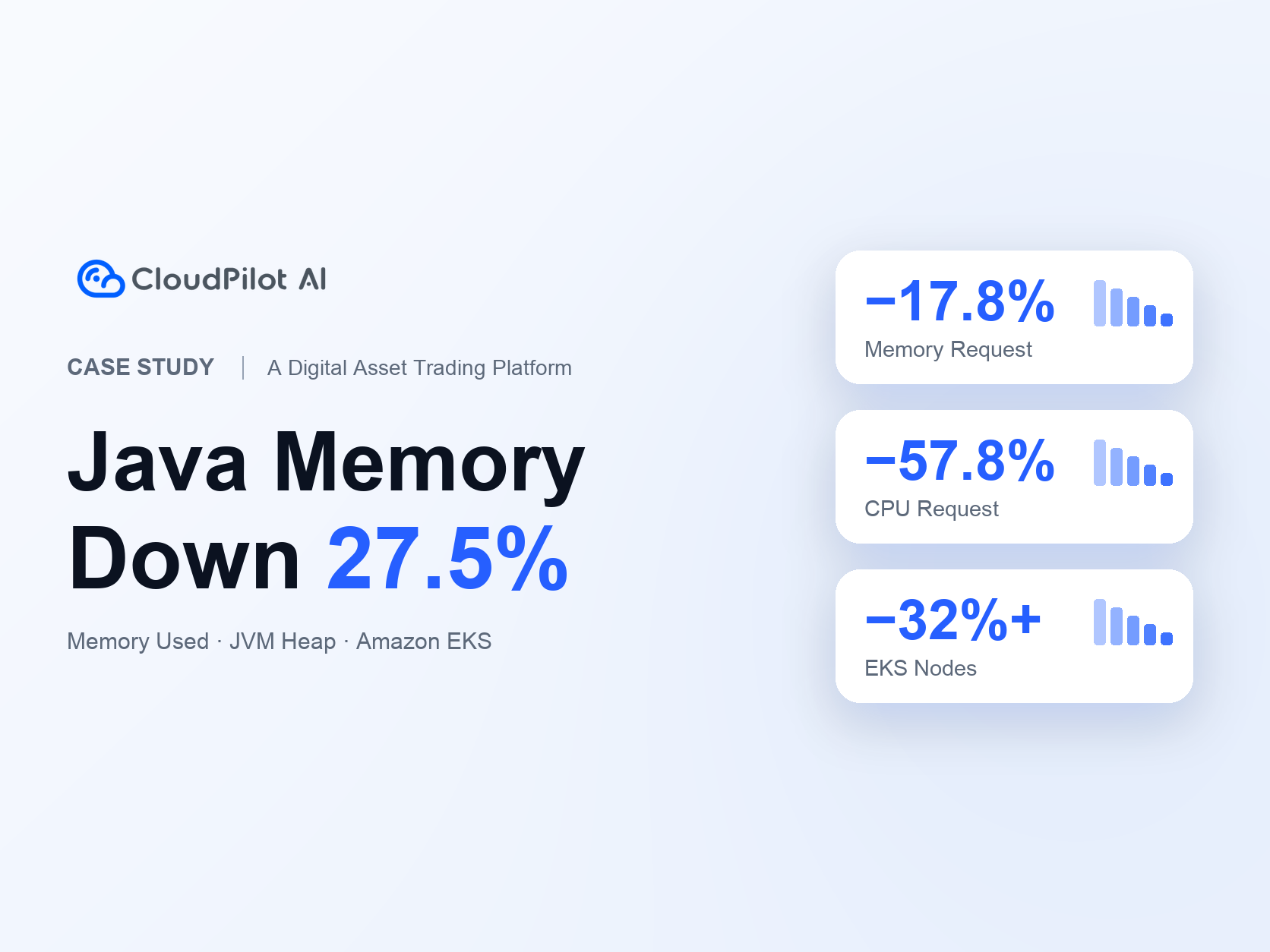
In a digital asset trading platform's EKS test environment, Java memory used fell 27.5%, Java memory requests fell 17.8%, and CPU requests fell 57.8%. EKS node count decreased by 32%+ alongside the customer's existing Karpenter setup.
Read the Java optimization customer story
Gaming Company Reports 47% Lower EKS Node Costs
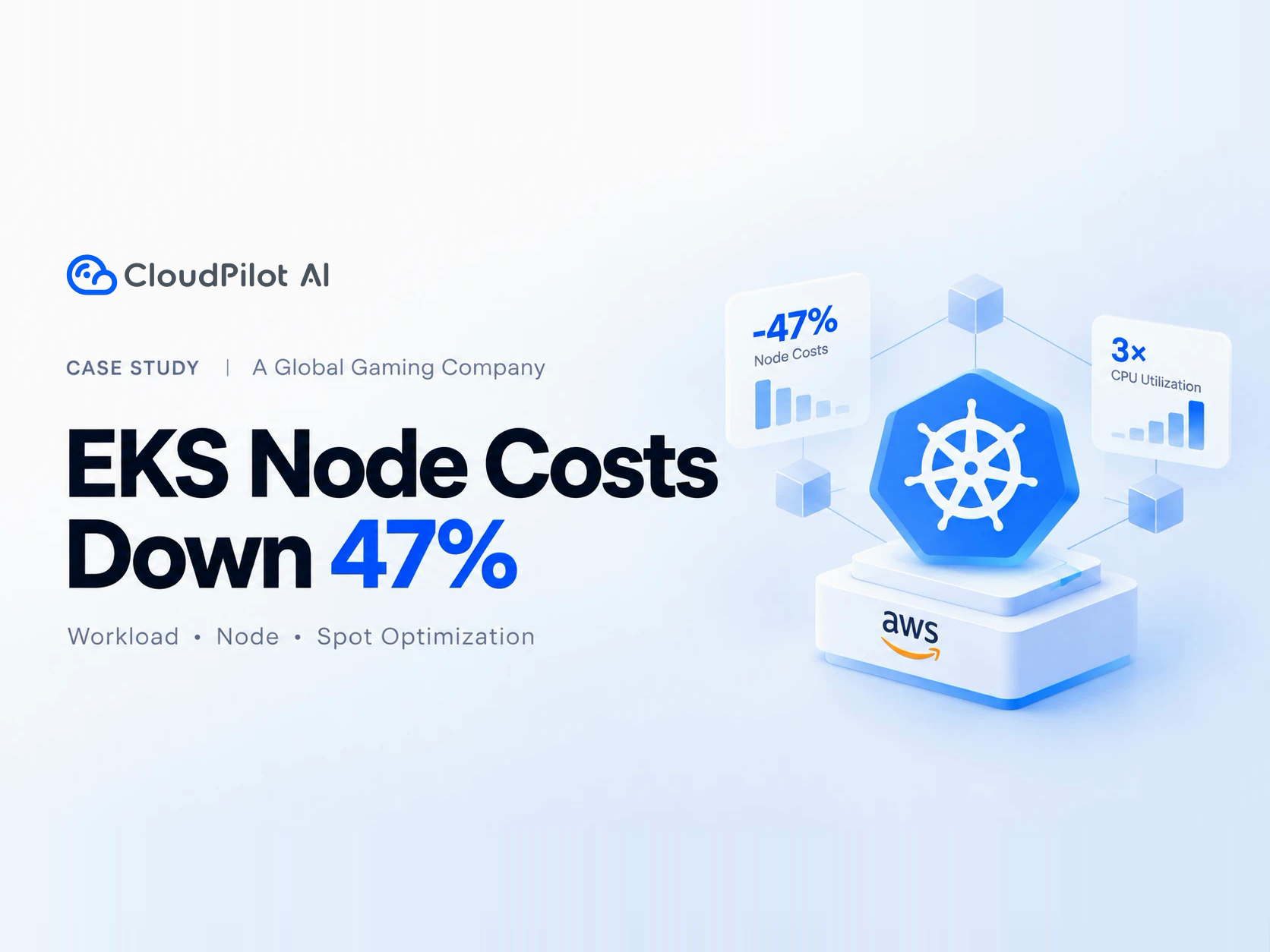
A global gaming company coordinated workload rightsizing, node optimization, and Spot Automation to reduce EKS node costs by 47%. CPU utilization tripled and required node capacity decreased by approximately 14%, without application code changes.
Read the gaming company customer story
SaaS Security: Nearly 49% Lower Node Costs in One Cluster
A SaaS security company unified workload optimization, P2P image delivery, Local SSD ephemeral storage, and placement controls across its EKS and GKE environment. In the featured cluster only, CPU requests fell 65.17%, memory requests fell 53.90%, and hourly node costs fell 48.63% between the reported snapshots.
Read the SaaS security customer story
News and Announcements
CloudPilot AI on Google Cloud Marketplace
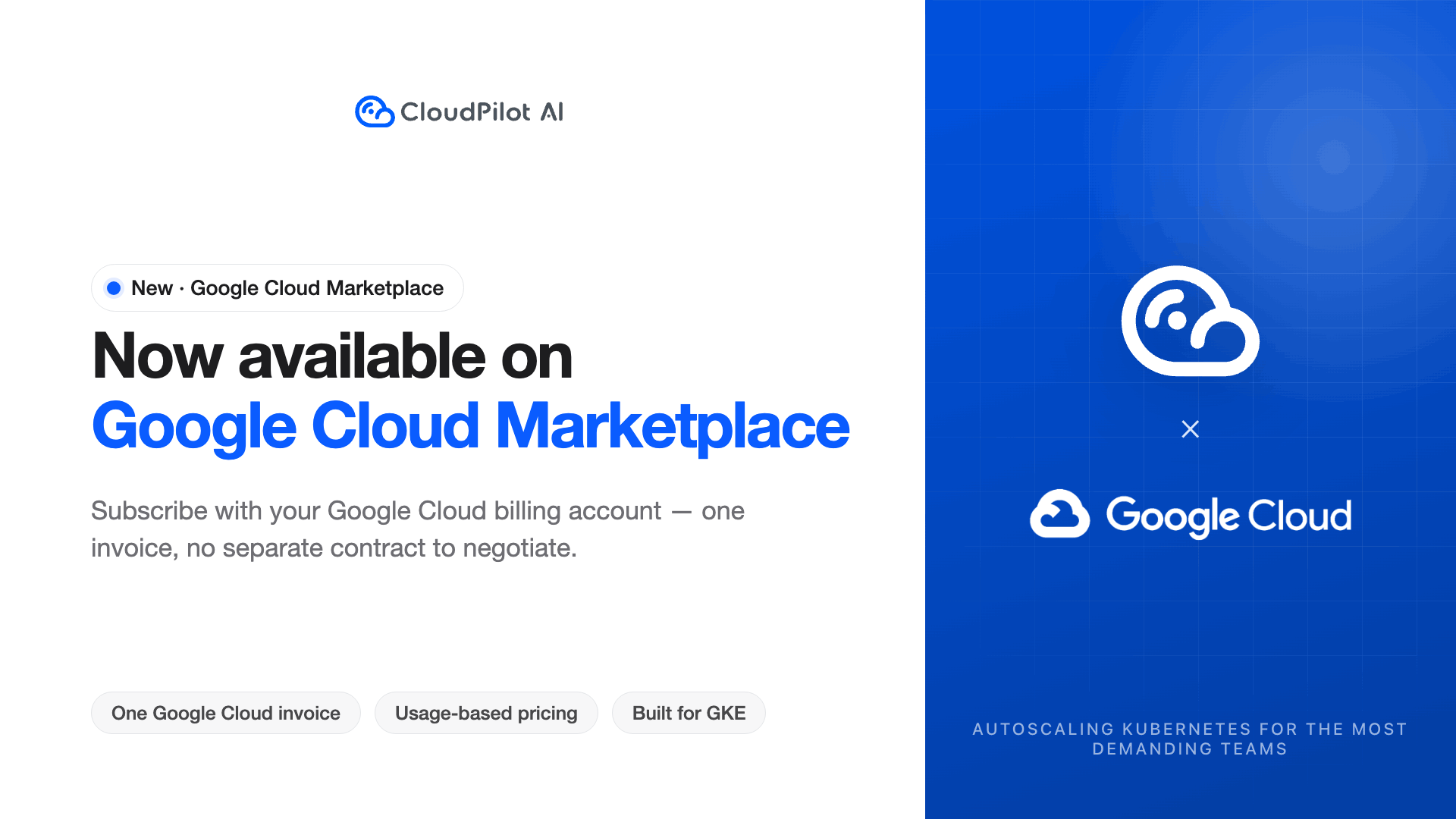
GKE teams can subscribe through their existing Google Cloud billing account, with usage-based pricing and CloudPilot AI charges on their Google Cloud invoice.
Read the Google Cloud Marketplace announcement
CloudPilot AI on Microsoft Azure Marketplace
AKS teams can subscribe through their Azure billing account. The CloudPilot AI General plan bills per managed vCPU-hour with no recurring platform fee.
Read the Microsoft Azure Marketplace announcement
Connect AI Assistants with the MCP Preview
The CloudPilot AI MCP preview lets compatible clients, including Codex and Claude Code, retrieve operational and optimization insights through an OAuth-protected, read-only connection. It does not provide general Kubernetes API access or configuration writes.
Read the CloudPilot AI MCP announcement
Explore CloudPilot AI on AWS Marketplace, Google Cloud Marketplace, or Microsoft Azure Marketplace.
Related articles
CloudPilot AI Is Now Available on Microsoft Azure Marketplace
AKS teams can now subscribe to CloudPilot AI on Microsoft Azure Marketplace with the Azure billing account they already use: one Azure invoice, usage-based pricing, and no separate contract to negotiate.
CloudPilot AI·3 minA Digital Asset Trading Platform Optimizes Java Services: Memory Usage Down 27.5%, EKS Nodes Down 32%+
A digital asset trading platform uses CloudPilot AI to align Java memory and Kubernetes resource requests with application demand, reducing Java Memory Used by 27.5%, Java Memory Request by 17.8%, CPU Request by 57.8%, and EKS node count by 32%+ alongside its existing Karpenter setup.
CloudPilot AI·8 minCloudPilot AI Is Now Available on Google Cloud Marketplace
GKE teams can now subscribe to CloudPilot AI through Google Cloud Marketplace with the billing account they already use: one Google Cloud invoice, usage-based pricing, and no separate contract to negotiate.
CloudPilot AI·3 minThe Kubernetes Autoscaling Brief
Once a month: what we see in the Spot market, one real cluster torn down, and what shipped.
No spam. Unsubscribe anytime.